Saturn
A world of icy rings
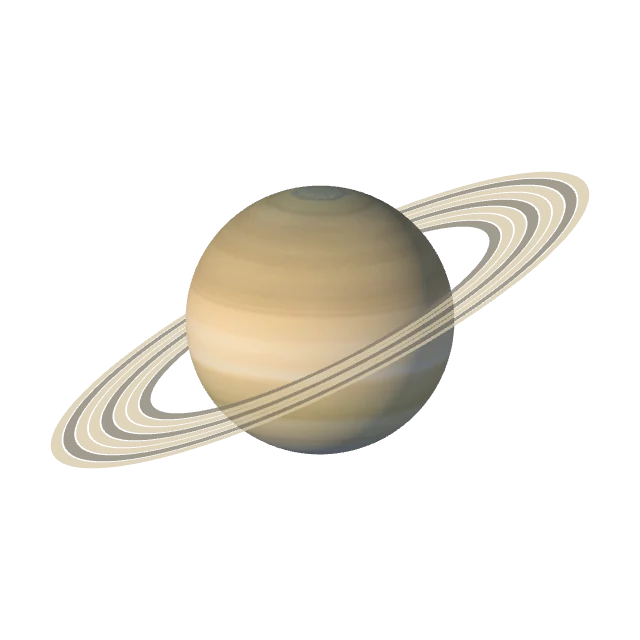
Saturn is easy to recognise by its wonderful rings. From far away they look like a wide, flat hat. But they are not one solid hoop! The rings contain many separate pieces of ice and rock. Some are tiny like dust, and others are much larger. Every piece follows its own path around Saturn.
The planet itself is a huge gas world with clouds and strong winds. It is far from the Sun and receives less warmth than Earth. Saturn has many moons. Titan has thick air, while Enceladus sprays icy fountains into space. The Cassini spacecraft explored this family for years.
At a glance
For children ages 4–7 and their grown-ups.
- Sixth planet from the Sun
- Equatorial diameter: about 120,500 km
- Year: about 29.4 Earth years
- Day: about 10.7 hours
Interesting facts
- Saturn is a gas giant.
- Its rings are made mainly of pieces of ice and rock.
- Titan is a large moon with a thick atmosphere.
Questions children ask
Can you stand on the rings?
No. The rings are made of many separate particles, not a solid road.
Does Saturn have moons?
Yes. Titan and Enceladus are two examples.
Source for facts and characteristics: NASA · Saturn
Explore more
In the planetarium you can spin this world and look at it from every side.
Sources and images
Celestial maps: Solar System Scope / INOVE · CC BY 4.0. Thumbnails were reduced and shaded. Artistic SVG maps were created for this project.