
Pluto
A distant world with an icy heart
Pluto is a small dwarf planet far beyond Neptune. It travels in a region called the Kuiper Belt, home to many cold, icy objects. People once called Pluto the ninth planet, then scientists made the naming rules clearer. Pluto itself did not change, and it is still a fascinating world!
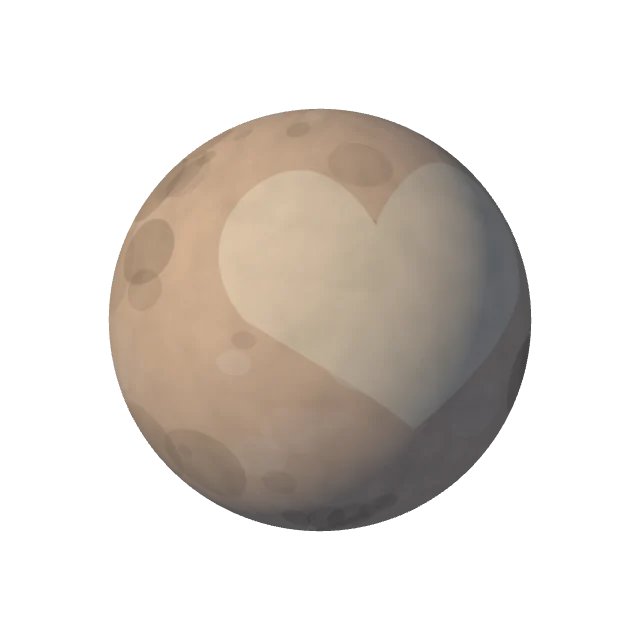
Water-ice mountains and broad frozen plains cover its surface. One bright area looks like a heart. Moons circle Pluto, and the largest is Charon. New Horizons flew past and showed us these amazing landscapes. From Pluto, the Sun looks smaller and shines more weakly than it does from our home on Earth.
At a glance
For children ages 4–7 and their grown-ups.
- Dwarf planet in the Kuiper Belt
- Equatorial diameter: about 2,377 km
- Year: about 248 Earth years
- Day: about 6.4 Earth days
Interesting facts
- Pluto is smaller than Earth’s Moon.
- A bright region on its surface looks like a heart.
- The New Horizons spacecraft flew past Pluto in 2015.
Questions children ask
Why is Pluto a dwarf planet?
It orbits the Sun and is nearly round, but has not cleared the neighbourhood around its orbit.
Does Pluto have a moon?
Yes. Its largest moon is Charon.
Source for facts and characteristics: NASA · Pluto
Explore more
In the planetarium you can spin this world and look at it from every side.
Artist’s impression · the surface is an illustration.
Sources and images
Celestial maps: Solar System Scope / INOVE · CC BY 4.0. Thumbnails were reduced and shaded. Artistic SVG maps were created for this project.